
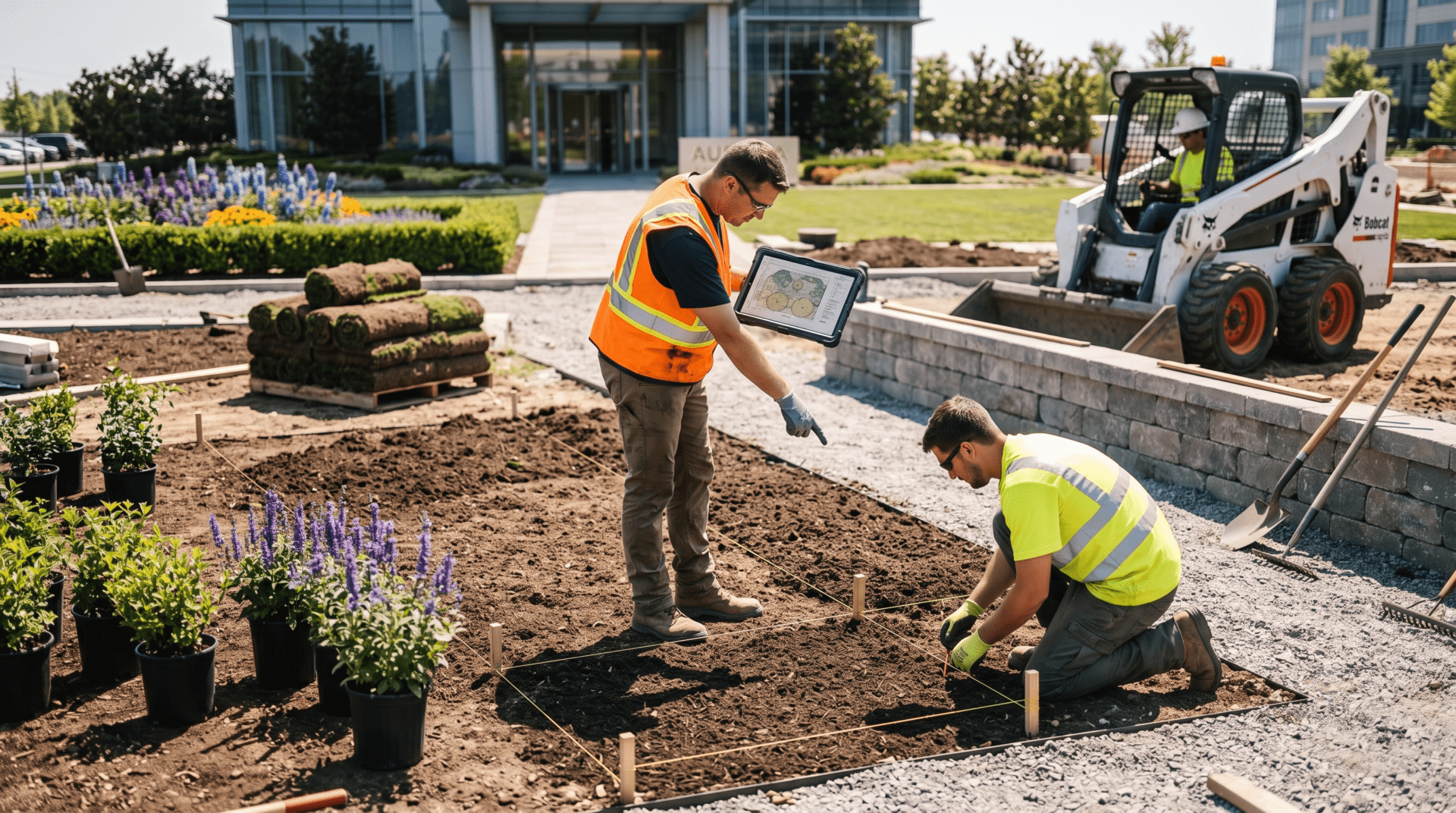
Have you ever looked at a beautifully landscaped commercial property and wondered how it all came together?
Behind every well-designed outdoor space is a structured process that most people never see. At Externals Landscape Services, we know that understanding how commercial landscaping companies plan and deliver projects helps businesses make smarter decisions and set more realistic expectations. Commercial landscaping is far more involved than planting a few trees and laying some turf. It starts long before a single tool hits the ground, involves careful coordination across multiple stages, and the first impressions a well-delivered project creates last well beyond completion.
It All Starts With Understanding the Brief
Every successful commercial landscaping project begins with a conversation, not a price estimate. Before we recommend anything, we take the time to build a deep understanding of what a client actually needs, not just what they think they want.
This distinction matters. A business owner might come to us asking for more greenery at the entrance, but through careful consultation, we discover the real goal is to improve how customers feel when they arrive. That insight changes everything, from plant selection to layout to lighting.
During this early planning stage, we ask questions that go beyond aesthetics:
- What are the unique requirements of this site and how it is used day to day?
- Who are the primary users: staff, customers, residents or visitors?
- Are there safety, compliance or accessibility considerations?
- What does the business want people to feel when they arrive?
Understanding a client’s business needs at this level allows us to design with genuine purpose. Planning without this foundation tends to produce grounds that look fine in photos but fail to serve the people who use them. For a closer look at what this role involves, our blog on the role of a commercial landscaping contractor covers the full scope of responsibilities.
Site Assessment: Reading the Ground Before Touching It
Once we have a clear brief, the next step is a thorough site assessment. This is where theory meets reality, and it is one of the most important stages in the entire process.
No two commercial properties are identical. Soil conditions vary significantly across Perth, from the sandy coastal soils of the western suburbs to the heavier clay profiles further inland. Understanding what is beneath the surface determines which plants will thrive, how drainage needs to be managed and whether any ground preparation is required before construction begins.
What a site assessment covers
A proper assessment of the outdoor space examines:
- Soil type and drainage to identify compaction, waterlogging risk or nutrient deficiencies
- Sun and shade mapping across different times of day and seasons
- Existing vegetation to determine what is worth keeping and what needs to go
- Services and utilities including irrigation lines, stormwater, power and gas
- Access and logistics for machinery, materials and ongoing maintenance
Skipping or rushing this stage is one of the most common reasons commercial landscaping projects run into trouble later. What looks like a straightforward outdoor area on paper can present real challenges once you start digging. Our blog on landscape design for commercial spaces explores how site-specific factors shape the design process from the ground up.
Design and Planning: Turning the Vision Into a Blueprint
With the site assessment complete, the design phase begins. This is where the brief and the site data come together into something tangible.
For larger or more complex commercial projects, landscape architects may be involved to produce detailed plans, elevations and specifications. For most mid-scale commercial work, our experienced team handles design in-house, drawing on years of project knowledge to produce layouts that are both practical and visually compelling.
Key design decisions at this stage
Landscape construction elements are mapped out in detail, including:
- Retaining walls where level changes need to be managed or defined
- Water features if they form part of the brief
- Natural stone or hardscape surfaces for pathways, seating areas or feature zones
- Softscape layouts covering planting zones, lawn areas and garden beds
- Lighting and irrigation integration planned from the outset rather than added as an afterthought
Getting these decisions right on paper is far less costly than changing them mid-build. A well-considered design also makes the construction phase smoother because every team member knows exactly what is going where and why.
For practical guidance on elevating the design phase, take a look at our blog on how to enhance your commercial landscape design.
Budgeting, Scheduling and Setting Expectations
One of the most common points of friction in any project is misalignment between what a client expects and what the budget or timeline actually allows. Getting everyone on the same page early is not just good practice. It is essential.
We approach budgeting transparently. Cost estimates are broken down by stage so clients can see exactly where their investment is going, whether that is earthworks, materials, planting or ongoing maintenance allowances. This level of detail helps businesses make informed decisions about where to prioritise and where to scale back without compromising the overall outcome.
Project timelines are built around realistic sequencing. Certain tasks must be completed before others can begin, and those dependencies need to be mapped out in advance. Rushing a schedule to hit an arbitrary deadline is one of the fastest ways to create quality problems and budget blowouts.
Respecting client expectations also means being honest about what is achievable within a given budget. We would rather have a direct conversation upfront than disappoint someone at handover. Our blog on managing large commercial landscaping projects goes deeper into how timeline and scope management works across complex builds.
Managing the Build: People, Equipment and Coordination
When construction begins, the quality of project management becomes the defining factor. A great design poorly executed is still a poor result.
On-site coordination involves scheduling the right team members with the right equipment at each stage of the build. Earthworks crews, irrigation specialists, planting teams and hardscape installers all have specific tasks and optimal sequencing. Overlapping trades without a clear plan leads to delays, rework and unnecessary cost.
How we manage the build phase
In practice, this means:
- Dedicated site supervisors who oversee daily progress and resolve issues in real time
- Staged delivery of materials to avoid site congestion and protect existing surfaces
- Regular progress updates so clients are never left wondering what is happening
- Quality checks at each milestone before moving to the next phase
- Safe work practices observed throughout the entire project, every day
The right equipment also makes a significant difference. From mini excavators for confined spaces to specialised planting machinery for large-scale installation, having access to purpose-fit tools means the job is done faster, cleaner and with less disruption to surrounding areas. For more on what qualifications and capabilities to look for, see our blog on qualifications of commercial landscaping contractors.
Working Around Weather and the Unexpected
Even the most carefully planned project will encounter the unexpected. In Perth, weather conditions can shift quickly, and seasonal factors play a real role in how and when certain tasks can be completed.
Heavy rain can make earthworks impossible and damage freshly laid turf. High winds create safety risks for elevated work and can stress newly planted specimens before their root systems are established. These are not excuses. They are realities that experienced commercial landscapers plan for from the start.
How we manage weather delays and the unforeseen
- Weather-sensitive tasks are scheduled with buffer time built into the project schedule
- Contingency plans are prepared for potential delays before work begins
- Clients are notified promptly when conditions affect project progress
- Where possible, indoor or sheltered tasks are brought forward to maintain momentum
- Materials are stored and protected on site to prevent weather-related waste
Transparent communication during these moments is what separates professional teams from average ones. Our clients never find out about a problem through a missed deadline. Our blog on top challenges in commercial landscaping covers how experienced teams navigate these situations without derailing the overall outcome.
Sustainable Practices Built Into Every Stage
Sustainability is not a feature we add at the end of a project. It is a lens we apply throughout the entire planning and delivery process, and it is increasingly important to clients across the green industry.
From the outset, we think about how the finished landscape will perform over time, not just how it will look at handover. That means selecting plants suited to Perth’s climate, designing irrigation systems that deliver water efficiently and minimise waste, and specifying materials with longevity and low environmental impact in mind.
A well-designed irrigation system is one of the most impactful sustainability decisions on any commercial site. Poorly designed systems waste thousands of litres per year, drive up utility costs and contribute to poor plant health. Getting it right from the start pays dividends for the life of the landscape.
When you choose to take care of your commercial grounds through a sustainably designed and maintained programme, you are making a long-term investment rather than a short-term fix. Trees and plants selected for the right conditions thrive with less intervention, reducing both maintenance frequency and cost over time.
Handover, Aftercare and Long-Term Success
Project completion is not the end of our involvement. It is the beginning of a relationship.
At handover, we walk clients through everything they need to know about their new landscape: which plants have been installed and why, how the irrigation system operates, what the initial establishment period looks like and what ongoing maintenance will be required to keep everything performing at its best.
This transition is critical. A landscape that receives the right care in its first season establishes far more successfully than one that is left to manage itself. Minimal disruption during the establishment phase, combined with a structured aftercare programme, is what turns a good-looking installation into a long-term asset.
Incorporating proper aftercare also builds trust. Clients who feel supported after the project is complete are more likely to return for future work and recommend our services to others. Delivering exceptional results does not stop at practical completion. It continues through every scheduled visit that follows.
To manage ongoing commercial garden maintenance with ease and protect the investment you have made in your grounds, a professional maintenance programme is the most sensible next step after any new installation.
Why Externals Does It Differently
There is no shortage of landscaping companies in Perth. What separates the average from the exceptional comes down to process, expertise and genuine care for the outcome.
As reliable commercial landscaping specialists, we bring a level of structure and professionalism to every project that gives our clients confidence from the first consultation through to long after handover. Our team has deep experience across a wide range of commercial sectors, from office and retail precincts through to education campuses, aged care facilities, government sites and industrial properties.
We do not cut corners to win on price, and we do not overpromise to win work. Our focus is on delivering quality outcomes that hold up over time, because that is what genuinely serves our clients’ interests.
What our clients tell us they value most:
- Consistent communication throughout every stage
- A team that shows up on schedule and follows through
- Honest advice, even when it means steering someone away from a decision that would not serve them well
- Grounds that still look great two years after we finished the job
That last point is the one we are most proud of. It is the truest measure of whether a commercial landscaping project was delivered well.
From First Spade to Lasting Grounds: Ready to Get Started?
What would it look like if your next commercial landscaping project ran smoothly from day one? The answer starts with choosing a team that understands the full scope of what is involved. Planning, design, construction, sustainability and long-term aftercare are not separate services. They are connected stages of a single, well-managed process, and every decision made at one stage shapes the outcome of the next. Getting it right from the start saves time, reduces cost and produces grounds your business can be genuinely proud of.
If you are ready to work with a team that takes every stage seriously, contact us today and let us talk through what your project needs.